
What to Look for in Quality Apparel: A 2026 Guide
Table of Contents
- Why Quality Apparel Matters More Than Price
- Understanding High-Quality Clothing Materials
- How to Check Garment Stitching and Seams
- Inspecting Hems, Buttons, and Hardware
- How to Read Clothing Labels and Care Instructions
- Evaluating Screen Printing Quality
- Your In-Store Inspection Checklist
- Cost Per Wear and Long-Term Value
- Frequently Asked Questions
Last Updated: October 11, 2026
Why Quality Apparel Matters More Than Price
The difference between a shirt that lasts two seasons and one that falls apart after five washes often comes down to details most people never think about. Understanding quality apparel is central to how Snowbird Studio sources and creates every piece.

Quality apparel is about longevity, feel, color retention, and seam integrity. When you're buying something that carries meaning, you want it to actually last.
The real cost of cheap apparel reveals itself over time. A shirt that pills after three months and fades after five washes ends up costing more than one that looks good for years.
Understanding High-Quality Clothing Materials
Fiber choice determines how a garment feels, breathes, wears, and survives repeated washing.
Natural Fibers: Cotton, Wool, Silk, and Linen
Cotton is the workhorse of quality apparel. Ring-spun cotton creates a softer, stronger yarn that resists pilling and holds color better.

Snowbird Studio uses 100% ring-spun cotton because it's durable, soft, and takes garment-dye finishes beautifully.
Wool brings warmth and natural stretch. Quality wool uses finer fibers (merino) or lower-micron counts and naturally resists wrinkles and odors. Wool requires careful washing to prevent shrinkage.
Silk offers luxury and breathability but requires gentle handling. For everyday wear, silk works best in blended fabrics where other fibers provide durability.
Linen creates structure and breathes well. High-quality linen softens with washing, becoming more comfortable over time.
Synthetic Fibers and Blends
Synthetic fibers serve specific purposes. Spandex (2-5%) adds stretch and prevents sagging. Nylon increases durability in high-wear areas. Polyester can be quality-engineered for softness when blended thoughtfully.
The key is intention. A 95% cotton, 5% spandex blend is engineered for comfort and shape retention. A 50% polyester blend might indicate cost-cutting. Read the fiber content and consider why each fiber is there.
Fabric Weight and Feel
Fabric weight directly correlates with durability. Heavyweight fabrics feel substantial, drape better, and age more gracefully than lightweight versions.
Quality apparel should feel smooth, not rough or plasticky. Garment-dyed fabrics tend to feel softer because the dye process is gentler on already-formed garments.
How to Check Garment Stitching and Seams
This is where quality becomes visible. Stitching and seams are the skeleton of any garment, and poor construction here means the piece falls apart regardless of fabric quality.
Stitch Consistency and Density
Turn a garment inside out and look at the seams. Quality stitching should be consistent throughout. Uneven stitching signals rushed production or worn machinery.
A quality seam typically has 12-15 stitches per inch. Double-needle stitching, where two parallel lines of thread run along a seam, adds strength and is a hallmark of durability.
Thread color should match the fabric, and stitches should be pulled tight and even.
Seam Finishing and Strength
Raw seams fray. Quality apparel finishes seams to prevent this. Common finishes include:
- Flat-felled seams (overlapped and stitched twice) are strong and smooth
- French seams (sewn, turned, and sewn again) are durable and neat
- Bound seams (covered with bias tape) are finished and flexible
- Serged seams (sealed with a serger machine) prevent fraying
If seams look raw and unfinished, the garment won't hold up to repeated washing. Snowbird Studio uses double-needle stitching and tubular knit construction to reduce stress points and extend garment life.
Inspecting Hems, Buttons, and Hardware
Hems, buttons, and zippers are where garments often fail first because they take concentrated stress during wear and washing.
Hems should be even with consistent, secure stitching. Double-stitched or topstitched hems are stronger than single-stitched ones. Check that hems don't pucker or pull.
Buttons should be sewn firmly with multiple passes of thread. Quality buttons are made from bone, wood, or high-quality plastic. The shank should be substantial enough that the button doesn't strain the fabric.
Zippers should slide smoothly without catching. Cheap zippers jam easily and separate unexpectedly. YKK and similar quality brands hold their reputation for a reason.
How to Read Clothing Labels and Care Instructions
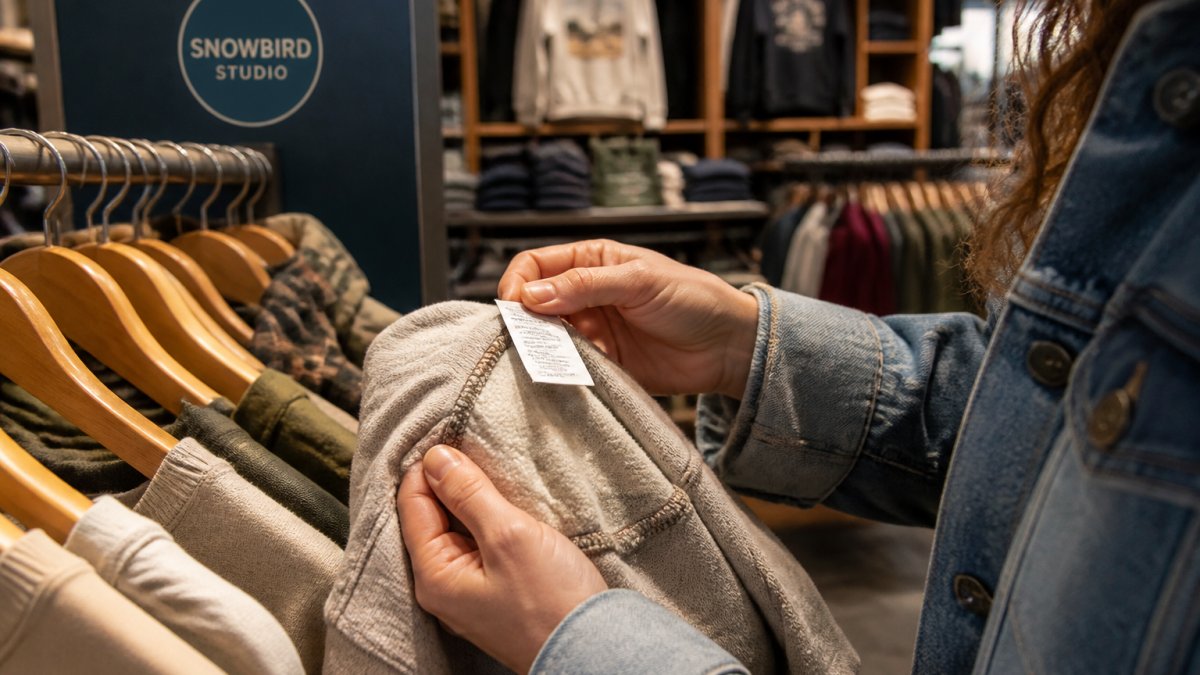
Labels tell you what you're buying and how to keep it that way. The fiber content label is legally required and is your first checkpoint. If a label says "100% cotton" but the fabric feels synthetic, something's off. Beyond fiber content, care instructions reveal the true cost of ownership and how much effort a garment demands.
Understanding Care Labels
Care instructions reveal how a garment was constructed. Machine-washable, cold-water garments are practical for everyday wear and reduce long-term costs. Pre-shrunk garments won't surprise you after the first wash.
Cold water preserves color and reduces fabric stress. Gentle cycles are gentler on seams and hardware; regular cycles are fine for sturdy, well-constructed pieces.
Highway 60 Autumn Scenic Route T-Shirt →
Drying instructions matter too. Machine-dry on low heat is convenient but can damage elastic, spandex, and printed designs. Air-drying extends garment life significantly, especially for pieces with spandex or screen-printed graphics. Tumble-dry on high heat is typically safe only for heavyweight, all-natural-fiber basics.
Preserving Quality Over Time
Once you own a quality garment, maintenance determines whether it lasts two years or ten. A few practical habits compound dramatically:
Washing: Turn garments inside out before washing to protect prints, dyes, and surface texture from abrasion. Wash similar colors together to prevent dye transfer. Use cold water for most loads; hot water fades colors and weakens fibers. Avoid overloading the machine; garments need room to move. Wash printed or delicate pieces on a gentle cycle, even if the label permits regular cycle.
Drying: Air-dry whenever possible. Hang or lay flat to dry.
Storage: Fold rather than hang heavy knits to prevent stretching at the shoulders. Use wooden hangers for structured pieces like jackets and blazers.
Addressing wear: Small repairs prevent small problems from becoming garment-ending failures. Most quality garments can be repaired by a tailor for a fraction of replacement cost.

Pilling and fabric care: Pilling (small balls of fiber on the surface) is normal and doesn't indicate poor quality; it happens to all fabrics with wear.
Certifications and Claims
Labels sometimes carry certifications or claims like "organic," "fair trade," or "sustainable." These are meaningful but don't guarantee construction quality. A garment can be made from certified organic cotton and still have poor stitching. Conversely, a well-constructed garment from conventional cotton will outlast a poorly made organic piece.
Country of origin alone doesn't determine quality, skilled factories exist worldwide. What matters more is whether the brand has quality control in place and stands behind its products. Snowbird Studio's apparel is pre-shrunk and machine-washable on cold, designed for people who want to actually wear what they buy without fussing over special care.
Evaluating Screen Printing Quality
Screen-printed designs should be crisp and vibrant, not blurry or faded. Run your finger across the print. Quality printing feels smooth, not plasticky or overly thick.
Look for ink consistency, no thin spots or heavy spots. The edges of the design should be clean, not bleeding into surrounding fabric. A well-printed design actually improves with washing because the ink bonds with the fibers.
Poor printing cracks and peels within weeks. Good printing lasts the life of the garment. Snowbird Studio's designs are printed to last because they're meant to be worn repeatedly and treasured.
Your In-Store Inspection Checklist
When you're shopping for quality apparel, bring this checklist. These are the things you can actually check before buying:
| What to Check | How to Inspect | What to Look For |
|---|---|---|
| Fiber content | Read the label | 100% natural or intentional blends; avoid vague percentages |
| Fabric weight | Feel the garment | Substantial, not thin or papery |
| Stitching | Turn inside out | Even, consistent, tight; 12-15 stitches per inch |
| Seams | Look at seam edges | Finished (not raw); flat-felled or serged preferred |
| Hems | Check evenness | Consistent stitching; no puckering or pulling |
| Buttons | Wiggle gently | Firm attachment; quality material (bone, wood, solid plastic) |
| Zippers | Slide slowly | Smooth motion; no catching or resistance |
| Screen print | Feel and look | Crisp edges; smooth texture; vibrant color |
| Overall fit | Try it on | Comfortable; seams sit properly; no pulling or bunching |
Start with fiber content and fabric weight. If those pass, move to stitching and seams. These four factors predict durability better than anything else.
Cost Per Wear and Long-Term Value
A $35 shirt worn 100 times costs $0.35 per wear. A $15 shirt worn 20 times before it falls apart costs $0.75 per wear. This simple math explains why quality apparel is actually economical.
Quality garments last longer because they're made to withstand repeated wear and washing.
Consider care costs too. A garment that needs dry-cleaning adds expense beyond the purchase price. Machine-washable, durable pieces eliminate that friction.
Think about emotional value as well. A piece that carries meaning, whether it's a design that reminds you of home or a garment that connects you to your heritage, gets worn more and treasured longer.
Finding quality apparel means looking beyond the price tag and understanding construction, materials, and durability. Snowbird Studio's vintage-inspired Canadian apparel is built with this philosophy: heavyweight ring-spun cotton, double-needle stitching, garment-dyed finishes, and designs that celebrate your connection to home. Shop All and discover apparel made to last and to be worn with pride.
Frequently Asked Questions
How can you tell the quality of clothes when shopping?
Quality apparel shows consistent, tight stitching with no loose threads or puckering. Check seams for reinforcement, examine fabric weight and feel for durability, inspect buttons and zippers for secure attachment, and read care labels for fiber content. Look for natural fibers like cotton or wool, and test the fabric's recovery by stretching and releasing it. A garment that feels substantial and holds its shape indicates better construction and longevity.
What should you check when inspecting a garment for durability?
Examine seam finishing (flat-felled or reinforced seams are stronger), count stitches per inch (12-16 is typical for quality construction), check that hems are evenly sewn, and verify button and zipper attachment is secure. Feel the fabric weight, heavier fabrics often outlast lightweight alternatives. Look for pilling resistance by rubbing the surface gently, and confirm that the garment is pre-shrunk or sanforized to prevent shrinkage after washing.
Is 100% cotton or a cotton blend better for quality apparel?
Both have merit depending on the garment. 100% cotton offers breathability and comfort, especially ring-spun varieties, which are softer and more durable. Cotton blends with spandex or nylon add stretch and reduce wrinkles, improving durability in high-wear areas. For printed designs, ring-spun 100% cotton with heavyweight fabric (6.1 oz or more) provides excellent durability and color retention. Choose based on the garment's purpose: pure cotton for comfort, blends for flexibility and wrinkle resistance.
How can you tell whether a printed design will last through washing?
Quality screen printing should feel smooth and slightly raised, with crisp edges and even color coverage. Run your finger across the design, it should not crack, peel, or feel stiff. Check the back of the garment; quality printing has minimal ink bleed-through. Verify the fabric is ring-spun cotton and pre-shrunk, as these support better ink adhesion. Read care instructions carefully; garments requiring cold water and low heat drying preserve printed designs longer than those needing hot water.
What does a clothing label tell you about quality?
Clothing labels list fiber content, care instructions, and sometimes manufacturing standards. Natural fibers like organic cotton or wool indicate higher quality potential. Look for percentages: 100% cotton or high-percentage blends (80% cotton, 20% spandex) often perform better than heavily synthetic fabrics. Sewn-in labels (rather than printed) suggest better construction. Labels mentioning pre-shrinking or specific fabric weights (like 6.1 oz heavyweight) indicate the maker invested in durability. Avoid vague labels that lack fiber percentages.
Why does fabric weight matter in quality apparel?
Heavier fabrics resist wear, pilling, and tearing better than lightweight alternatives. A 6.1 oz cotton tee feels more substantial and durable than a 4.5 oz shirt. Heavier fabric also holds its shape longer, maintains color better, and provides better comfort in varied climates. For printed designs, heavyweight fabric supports ink adhesion and reduces cracking during washing. Check the product description or label for fabric weight in ounces per square yard (oz/yd²) or grams per square meter (g/m²).
What is the difference between quality apparel and fast fashion?
Quality apparel uses higher-grade materials (natural fibers, heavyweight fabric), consistent and reinforced stitching, and durable construction methods like double-needle seams and flat-felled seams. Fast fashion prioritizes low cost and quick production, often using thin synthetics, loose stitching, and weak seam finishing. Quality pieces last years and improve with wear; fast fashion deteriorates within months. Quality brands often provide transparent fiber content and care instructions, while fast fashion obscures durability details. Cost per wear favors quality apparel over time.